

In defense of the question mark: an American’s Oxford year
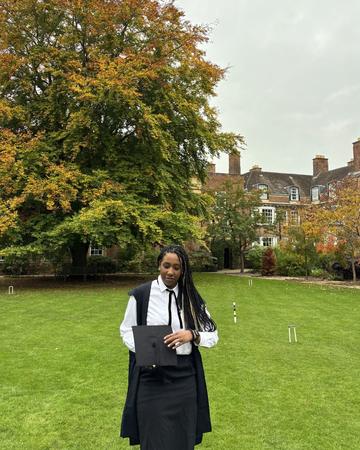
Jessi Rich shares her experience as an MSt student in World Literatures in English at the University of Oxford.
Around two months before I was set to arrive at Oxford, a movie came out on Netflix that was—at least on paper—so suspiciously relevant to me I wondered if I was being watched. The story followed an American girl moving to England to pursue a masters in English at the University of Oxford. It was quite originally titled: My Oxford Year.
If you’ve somehow escaped it up to this point, don’t necessarily take this as a sign to watch it. In fact, the film—which is hardly about Oxford at all—only renewed my staunch insistence to go into my master’s program abroad with zero expectations, to arrive with a clean slate, as it were. Not that this slate was all that clean. Up to the day I boarded my flight it was full of question marks. What if I don’t know enough? What if it makes me hate literature? What if I can’t make any friends?
With two out of three terms under my belt now, it’d be nice if I could say I’ve drawn cohesive conclusions for all of those questions, but questions tend to lead to more questions. This is the nature of research. Most of these questions, however, huddled beneath one umbrella: a fear of difference.
I mean this in more than one sense. First, in My Oxford Year the American is so American that everyone cannot stop commenting on how American she is. Don’t get me wrong—I knew this would not be the case, and that it was wildly unrealistic that the protagonist was the only American student within a ten-mile radius. I was still concerned about culture shock, about saying the wrong thing, about accidentally offending someone.
At the same time, I was entering a program that was largely book-focused, coming from a background that was more multimedia—books, visual art, film, video games, etc. I admit I still don’t understand the concept of a literary canon, and if there is a canon I should know, I’ve probably barely scratched the surface of it. My first few seminars here were a maelstrom of authors’ names I didn’t know and critical theories I was unfamiliar with. I wondered: am I in the right place?
So yes, follow all of these question marks back to their source and it becomes a fear of difference, of being different, of existing in a different place. What I’ve found, though, is the natural anecdote to all these question marks is curiosity. This, too, is the nature of research.
I enjoy the differentness of my surroundings. Oxford bleeds history deeper than I can fathom, coming from a place which has not existed (at least by the U.S. Constitution’s definition) as a nation for all that long. Several buildings have stood in the same place for over four hundred years, even as they stand beside modern glass structures and sweeping green spaces. My first few days here all I did was walk, going down any cobblestoned alley that caught my eye. Rather than being afraid of the differentness, I gave into it, and in that way the atmosphere and architecture of Oxford has become one of my favorite parts of studying here.
In the same way, Oxford boasts a large international student body. People come from every corner of the world, and from every dimension of academic experience. I’m fascinated by my peers' perspectives and ideas and have found that they are likewise interested in mine. I may have to meet all of my essay deadlines on my own, but the education itself is born from collaboration.
Even as I step into my last term here, I’m sure the question marks will continue to multiply, but I’m comfortable with that. Question marks have led me to essay projects that I’ve thoroughly enjoyed working on, as well as extracurriculars like the Language Café and Oxford’s K-Pop society. My Oxford year so far has looked nothing like Netflix’s, but by asking all the questions, meandering down all the alleys, I’ve certainly made it my own.

