

Professor Tamara Atkin identifies rare medieval manuscript fragments in Guernsey archive
(c) Max Rhydwen-Jones/States of Guernsey
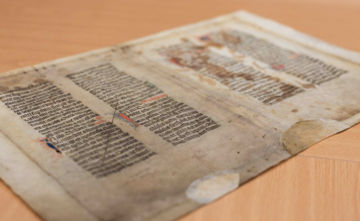
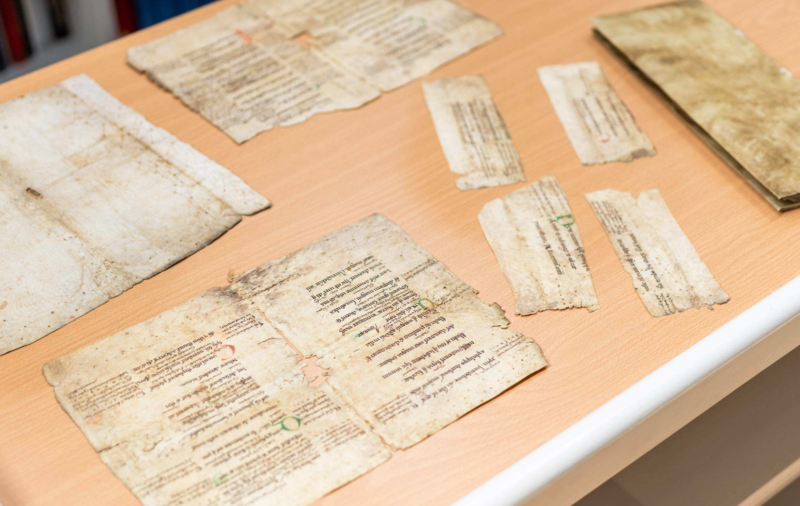
Earlier this year, Professor Tamara Atkin co-led a research team, alongside manuscript expert Dr David Rundle (University of Kent), which identified seventeen medieval manuscript fragments at Guernsey’s Island Archives, offering an unprecedented insight into the island's literary and intellectual life in a period from which almost no such evidence has survived.
The fragments of medieval text have all been hidden in plain sight, reused centuries ago as covers for early modern notebooks. Found within the collections of the Island Archives and among the records held in His Majesty's Greffier’s Strongroom, they had been repurposed as bindings for administrative records relating to the island's feudal holdings and have been quietly preserved for centuries by the act of reuse.
Some of the fragments have come to light for the first time, while others had been noted by Guernsey archivists in the past, though their rarity and the significance of what they represent is only now being fully understood through academic study. When viewed together, the seventeen fragments form a collection of real importance.
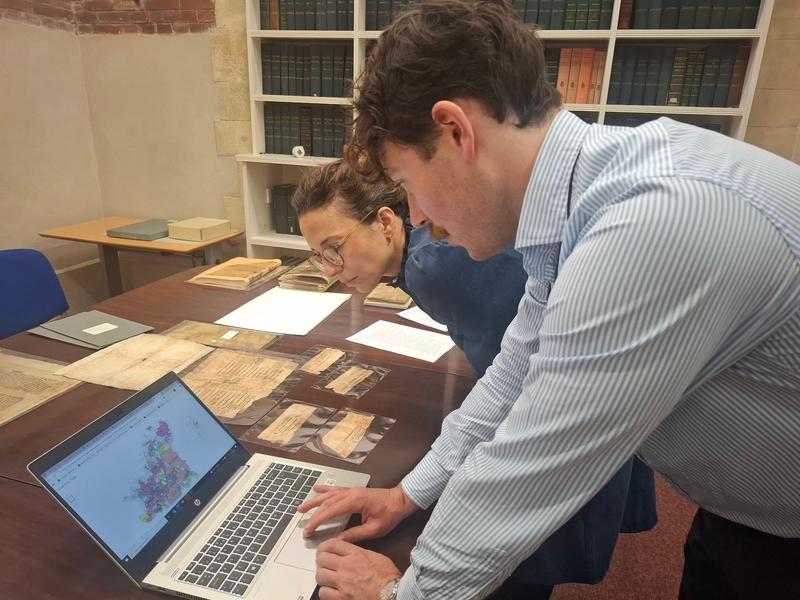
Photo by David Rundle.
Taken together, the surviving fragments suggest that late medieval Guernsey was home to keen readers, and that when they read in the vernacular, they read in French rather than English. While many of the fragments are in Latin, six of them are in French, most are popular works that survive in several copies across England and France, such as the Anglo-Norman Lumere as lais.
Each fragment also tells its own story, offering different perspectives on how texts were shared, used and preserved, and collectively they point to something distinctive about Guernsey itself.
Professor Atkin commented:
Ask most people, including scholars of medieval and early modern literature, what they know about the literary culture of premodern Guernsey, and the answer that you'll invariably get back is ‘not much’. These discoveries by the team at Island Archives transforms what we can now say about Guernsey's medieval manuscript culture. They offer definitive evidence of Guernsey's medieval literary and textual culture and reveal that books of several kinds - scholastic, liturgical, and literary - were available on the island.
The subsequent reuse of these fragments as covers for the island's administrative records allows us to glimpse at local binding practices and highlights the extent to which the careful husbandry of resources was a feature of island life. That these practices are not unique to Guernsey also sheds light on the island's cultural and administrative links to the French and English mainlands.
The manuscript fragments were uncovered by Callum Tostevin-Hall, an archives assistant at Island Archives. He was retrieving a 16th-century copy of Edward III’s 1331 Extente of Guernsey from the archives when he noticed a reference to a vellum cover with Latin text which had been removed from the book in a previous round of conservation. He said, "I checked this cover and was astonished to find that it was clearly a reused bifolium from a medieval manuscript. The project has been a real baby of mine and seeing it finally come to fruition, as well as being able to lay claim to the discovery of several of these manuscript fragments, is both an honour and a privilege.”
To introduce the discoveries to a wider audience, Island Archives will host an academic study day on 10 September 2026. The day will feature a round-table discussion with subject expert academics from the UK and France, a hands-on study session with the fragments, and a public talk open to the local community.
The event aims to raise awareness of the fragments and to encourage the further scholarship they invite. Tickets to the public talk are available through Eventbrite.
(c) Max Rhydwen-Jones/States of Guernsey

