
Rhodes House inscription: interview with George Parkin award-winners Elleke Boehmer and Luan Staphorst
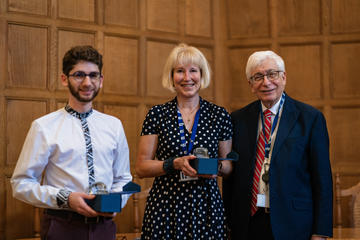
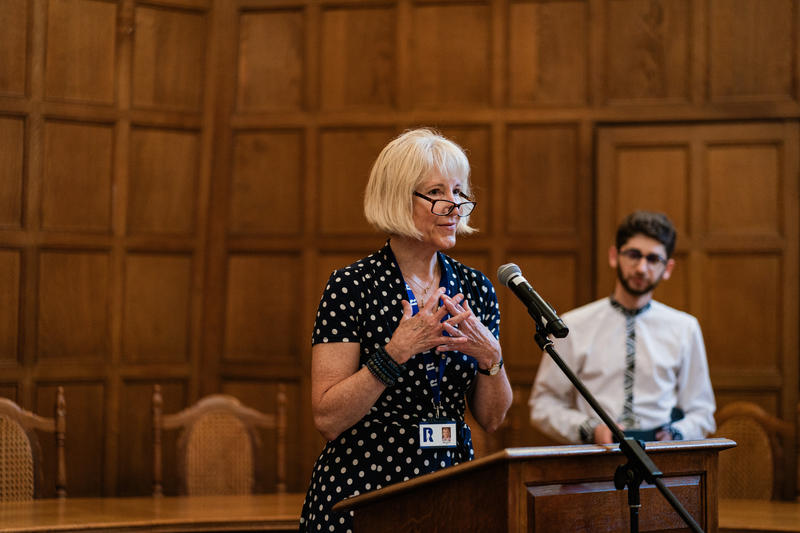
Professor Elleke Boehmer and DPhil candidate Luan Staphorst have recently been awarded the George Parkin Distinguished Service Award for their work on an inscription acknowledging the difficult Rhodes legacy, which has been carved into a stone arch at the back of Rhodes House. The award recognises extraordinary volunteer service to the Rhodes Trust.
Elleke and Luan were commended for their contribution to the project which permanently and visibly addresses the Trust's history: "Their collaboration has left a profound and enduring legacy, embedding acknowledgement and inclusion into the very fabric of Rhodes House for future generations."
In this interview with Elleke and Luan, we find out more about the project and their contribution.
Could you tell us a bit about your research and academic interests, and how they feed into this project?
Elleke: My research interests are cross-period and wide-ranging with my most recent monograph, Southern imagining, a literary and cultural history of the far southern hemisphere (Princeton) offering a case in point. In the book, I advocate for seeing the world more holistically by viewing cultures and geographies ‘from below’, that is, from roughly the vantage of the Southern Ocean, the classical ‘edge of the world’ from the time of Ptolemy. One key methodology for doing so, which is why I embraced this Rhodes parapet project with open arms, is to work with, draw out and amplify some of the indigenous languages of this far edge of the world, no matter how erased or seemingly unused they are to us now, to help us to view the world from there rather than here. Southern words, I argue, are naturally more aligned with southern environments than words from a northern global language like English. This linguistic retrieval or revival also helps with interrogating hierarchies of perception and reception in which the north is always dominant and hence seen as more influential.
The new parapet inscription at the refurbished Rhodes House for which we received our George Parkin awards, involves speaking back to the legacy of the imperialist Cecil John Rhodes who founded and funded the world-famous Rhodes Scholarships, and endowed many Oxford initiatives. His memory is commemorated in Latin, in large Times Roman lettering that runs along the Rhodes House cornice at the back of the building. The |xam inscription, now carved lower down on the same side of the building, rising from Luan's outstanding and inspired help with the translation, is in dialogue with those words. The English words were crafted by a cross-generational group of Rhodes Scholars from around the world, working in response to the Rhodes Must Fall and Black Lives Matter movements. The words are: ‘Remembering and honouring with our work, now, the labour and suffering of those who generated this wealth’.
Luan: My DPhil research centres on a 19th century |xam archive and the ways in which South African authors and scholars have responded to this collection in both their creative and critical work. This is one expression of a broader research theme I have been exploring through various avenues over the past decade, i.e. the afterlives of the |xam in contemporary South Africa. Considering the inscription at Rhodes House is aimed at addressing the legacies of colonialism – which includes the extinction of |xam – translating the inscription was an opportune chance to marry my research interests with broader questions about addressing the presence of the past in the present-day.
|xam is no longer spoken – how did you go about learning the language and translating the inscription?
Luan: Whilst it is true that |xam is no longer spoken as a home language, it has influenced a number of languages in southern Africa - most notably Afrikaans, my mother tongue. Further, my late maternal grandfather, Pieter Etsebeth Myburgh, was the last known person that I have been able to identify to have known a smattering of the language. I approached the study of |xam as an opportunity to delve deeper into my own mother tongue's |xam roots and consequently to speak with my ancestors – some of whom were |xam. I approached the inscription as an opportunity to bring this complexity to the fore. The reader with a knowledge of Afrikaans, Khoekhoegowab, and N|uu – all languages related to |xam in one way or another - will see traces of these living languages in the |xam inscription. In reflecting on this layered translation, we consulted Ouma Katrina Esau, the last known living speaker of N|uu, and her granddaughter Claudia du Plessis, in the Kalahari. And, very importantly, the archival voice of ||kabbo |uhi-ddoro Jantje Tooren, the most prolific of the 19th- century |xam narrators to have been transcribed, influenced the translation in innumerable ways.
Elleke: The main response to this question rightly comes from Luan, the lead translator on the project. I would merely chip in to say that the fact that Luan was here at Oxford researching on the |xam archive and its presence in South African 20th and 21st-century literature, under my supervision, at exactly the time that the Rhodes Trust was in quest of a translator to work on the parapet wording, was pure serendipity. It was an alignment of the stars and planets from which the Rhodes Trust and arguably the wider University have greatly benefited, and will continue to do so as long as Rhodes House stands.
How does it feel now that the project is complete?
Elleke: Now that this phase of the project is rounded out, and the parapet inscription stands, it gives a quiet feeling of satisfaction. But also the sense that there is so much more to do, not only to revive and revitalise southern indigenous words to speak to southern realities, and but also to illuminate the legacies of colonialism in Oxford. Personally, I will never forget the expression on the faces of Ouma Katrina and her grand-daughter Claudia Du Plessis, the two women from the Kalahari N|nu community who Luan also mentions, as we consulted with them about the wording and emphasis of the translation. When the two women heard that these words would be written in an ancestral Khoi language on a stone building in England, in a place of ancient learning, they were moved almost to tears.
Luan: It is exciting to see |xam words inscribed for posterity in Oxford – a place that few of the |xam themselves would ever have known about, and yet which, through its ties to a colonial intelligentsia, had an irrevocable impact on their lives and culture. At the same time, this is but a part of what ought to be a much larger project on thinking through the ways in which colonial legacies could be addressed in Oxford. The project, in my mind, has only just begun.
Where will your research take you next?
Luan: The linguist Lucy Lloyd dedicated Specimens of Bushman Folklore (1911), the first collection of published material from the |xam archive, to the small band of "faithful workers" who laboured on all-things |xam. More than a hundred years later, the band is still small, but no less faithful. There remains much more to be done in |xam studies. I foresee my future being saturated with the fascinating and yet troubling legacy of one of southern Africa's most consequential cultures.
Elleke: I chime with Luan in saying that the important work of retrieving and reviving linguistic and other cultural traditions from the far south remains pressing and ongoing. My book Southern Imagining really just constitutes for me the opening phase of a continuing and growing project, on which I look forward to working with others like Luan to bring out and highlight responses to the dominant north from the (to date) unjustly overlooked south.