Tell us about your research interests
I’m interested in why we speak the way we do, how we hear each other, and how these relate to the mind and the social structures we inhabit. So I study accents, dialects, spoken interaction, and language and social change over time.
Which book has had the biggest impact on you?
When I was a teenager, Crime and Punishment showed me what novels can do. W. H. Auden, the same for poetry. A ghastly book named The Naked Ape made me realise I wanted to study human behaviour. More recently, Daniel Kahneman’s Thinking Fast and Slow changed how I think about how people speak.
What do you do in your spare time?
Panic about how to use it.
If you could live anywhere in the world, where would that be?
I lived in eight countries as a child, so my dream was just to stay in one place for a while. I fell in love with London as a teenager and was lucky enough to return. I love the cultural chaos of East London and being able to travel anywhere. So I think I’m where I’d like to be.
As a child, what did you want to be when you grew up?
An illustrator. I studied art for years and worked as a professional graphic designer and illustrator for a year before I realised how much I missed linguistics.
Who had the greatest influence on you during your childhood?
My parents, because we moved so often. I didn’t realise it then, but I now see that I learned almost everything about life from them.
What teacher had the greatest impact on you?
When I was 10, my teacher Mr. Ward drew a comic strip every week. It featured him as a superhero named Superspell, the villains Miss Stake and Miss Spell, and all of us. Every Friday, after our spelling test, we’d turn the page and read the latest issue. When my best friend moved away, the story featured me on a quest that ended with a packet of Rowntree’s Fruit Gums stuck under his Renault (he trained us to respect Renault and despise Fiat, which I do to this day). He read us The Twits and refused to confirm or deny that he stored things in his huge beard.
Were you popular as a teenager?
I think I made being uncool cool but I’m not sure anyone agrees.
If you could have dinner with five famous people from history, who would they be?
A few people who come to mind – Helen Keller (with Anne Sullivan), Agatha Christie, Emperor Ashoka (or Akbar the Great if he’s not free), Dylan Thomas, Marie-Antoine Carême (to produce the menu I saw displayed at the Royal Pavilion in Brighton). Maybe not together.
How would your friends describe you?
Reluctantly.
What do you like most about your job?
The subject I study, the joy of learning with students and colleagues, having such varied tasks, and the flexibility, compared to other jobs.
Why are we here?
42? In the parable of the poisoned arrow, Buddha teaches his disciples to ask how to be here, not why. Self-awareness, by training the mind to be detached, helps us enjoy the absurd and breathtaking fact that evolution happens to have deposited us here now.
If you weren’t a member of the English Faculty, what would you be?
A member of the Linguistics Faculty. Or an illustrator.
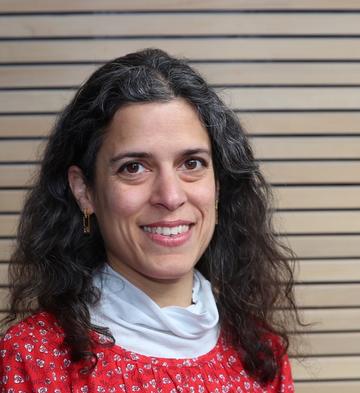
Devyani Sharma FBA is Professor of Language and Communication at the University of Oxford. Her research examines how new accents and dialects develop, migration and inter-ethnic contact, generational change in language and social systems, speech style, attitudes, and bilingualism. She is the author of From Deficit to Dialect: The Evolution of English in India and Singapore, and her co-edited works include Research Methods in Linguistics, The Oxford Handbook of World Englishes, English in the Indian Diaspora. She is currently leading a project on variation and change in London English across ages and generations (https://generationsoflondonenglish.org/).