Tell us about your research interests
My work intersects global modernism, philosophy, and poetics. I wrote my doctoral thesis on Samuel Beckett’s poetry. My current book project moves in a slightly different direction: it focuses on lines (verse lines, grids, drawn lines, thresholds, outlines, party lines) that shape Indian modernist poetry.
I am currently busy with three side quests, which will hopefully end up as articles: Arun Kolatkar’s serial poems and the aesthetic of breakdown; punctuation in Samuel Beckett’s late prose and the stakes involved in longer sentences; translating Guy Cabort Mason’s damning letter to Aimé Césaire from French and studying its implications for Cahier.
Which book has had the biggest impact on you?
Gajanan Madhav Muktibodh’s long poem, Andherein Mein (In the Dark). I like to think that reading it helped me cross both a sound and a sense barrier. Other books that have been vital to me at different points: Robert Bresson’s Notes on the Cinematographer, Nan Shepherd’s The Living Mountain, W.G. Sebald’s Rings of Saturn, and Pradip Krishen’s Trees of Delhi.
What do you do in your spare time?
Bouldering, running in port meadow, hiking (or bookmarking future hikes), cooking extensive meals, curating playlists, learning languages.
Describe your ideal day.
Thursday, with a hint of Friday.
If you could live anywhere in the world, where would that be?
Chitkul on the Indo-Tibetan border. Barring that, somewhere in the Hebrides.
As a child, what did you want to be when you grew up?
A MotoGP racer.
Who had the greatest influence on you during your childhood?
My mother’s singing.
Who were your childhood heroes?
Ash Ketchum, and Trishanku, for his sly act that opened a second heaven.
What teacher had the greatest impact on you?
My high school English teacher, Priya Singh, for inspiring independence in everyone she taught. Also, my Wordsworth professor from Delhi, Sunjay Sharma, whose exhaustive (forty-hour-long) reading of ‘Tintern Abbey’ shaped my understanding of poetry, and taught me what it takes to share the excitement of a literary encounter.
Do you have pets?
Yes, two kittens: Fitz and Didi (Hindi for sister).
Were you popular as a teenager?
I would think so. Unless the testimonials in my Grade 7 scrap book are lying: ‘bad boy, good grades’.
What is your favourite music?
I regularly return to the following pieces: Ebo Taylor’s Love and Death, Kishori Amonkar’s Jaunpuri, Brian Eno’s Thursday Afternoon, Hildegaard Von Bingen’s Canticles of Ecstacy, and Sons of Kemet’s Your Queen is a Reptile.
If you could have dinner with five famous people from history, who would they be?
So many possible combinations, and seating plans. Here’s one: Agnés Varda, Amir Khusrau, Ada Lovelace, Bhartrahari, and Walter Benjamin.
Why are we here?
To quote Pico: ‘magic is nothing other than marrying the world’.
If you weren’t a member of the English Faculty, what would you be?
Almost definitely a pastry chef.
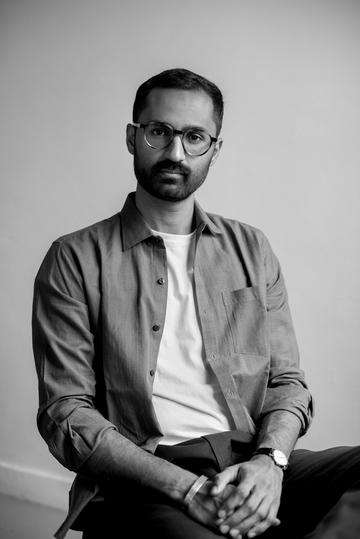
Mantra Mukim is a Leverhulme Early Career Fellow at the Faculty of English, University of Oxford. He was educated, and has taught, in Delhi, Warwick, and Paris. He is the author of Samuel Beckett’s Lyric Failure (2025), and with Derek Attridge, the co-editor of Literature and Event: 21st Century Reformulation (2022). His current work investigates line and lineation in global modernist practices.