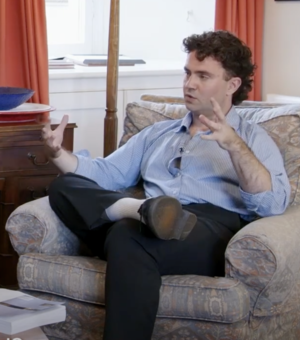
My research is concerned with poetics – that is the making of literary texts – and aesthetic philosophy. Particularly I am interested in the effects that poetry has on our minds and on our ethics. And more particularly still, all my writing shares an interest in the ways that literary forms make demands on us to be more magnanimous and to move towards empathy. I usually work on Romantic and Victorian literature, where I am particularly interested in Wordsworth, Coleridge, Keats, Hemans, Tennyson, Rossetti, Hopkins, Swinburne, and Housman. But I have also published on Milton, T.S. Eliot, and as well as on English literature, on poetry in German, French, and Latin. Philosophers of particularly interest to me include Plato, Augustine, and Plotinus; Hegel, Marx, and Adorno; Murdoch, Cavell, and Nussbaum.
I am currently finishing a book titled The Ends of the Line: On Poetry and Ethics. It considers how the poetic line-ending is involved in the experience of ethics, and how Romantic and Victorian poets characterised this relationship. The book considers poetic education in the nineteenth-century classroom, the rediscovery of Neoplatonic writings, and the manuscript history of well-known Romantic and Victorian poems. Early work from this project has included essays on Gerard Manley Hopkins’s reading of St Augustine, and the influence of Plotinus on Samuel Taylor Coleridge.
My new project turns these interests towards Jewish authors in the nineteenth century. Provisionally titled The Philosophy of Form and the Question of Jewishness, the book explores well-known authors (for instance, Benjamin Disraeli, George Eliot, Amy Levy), less well-known authors (Grace Aguilar, Israel Zangwill), and interlocutors in other artforms (Richard Wagner, Solomon Hart), to consider what Jewishness meant in nineteenth-century culture. Often these thinkers come back to questions of form, whether in relation to verse, political theory, racialisation, or epistemology. The book will therefore show how the history of what we know as ‘form’ is intimately bound up with Jewishness. Although centred on Anglophone authors, the book also draws on the development of the Yiddish novel and the influence of Hebrew philosophy. I have published early work from this project on Simeon Solomon’s prose poetry.
I am also involved in a number of collaborative projects. I recently was co-editor of a collection of essays reconsidering theories of influence, half a century since Harold Bloom’s The Anxiety of Influence. And with Anna Nickerson, I am editing a collection of essays on Hopkins and his work as a classicist.
I teach Prelims Papers 1B, 3, and 4; and FHS Paper 5. I supervise graduate work in my areas of interest.
Before joining Somerville, I taught at St Peter’s and at Trinity College, Cambridge. I was previously Procter Fellow at Princeton University, and I am currently a research fellow at the Pharos Foundation, and a Senior Member of Trinity, Cambridge. I took my BA and MSt from Magdalen, Oxford, and my PhD from St John’s, Cambridge.